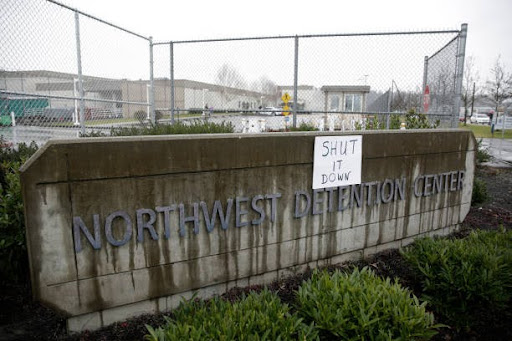
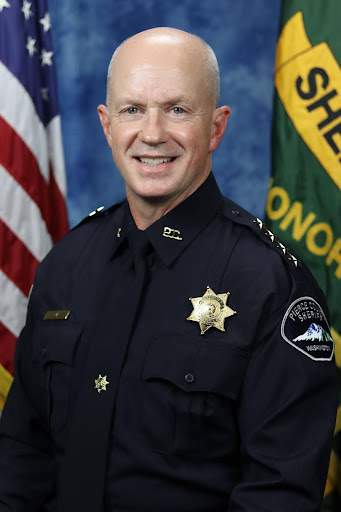
On April 10, Sheriff Swank met with the U.S. Immigration and Customs Enforcement (ICE) Seattle Field Office Director Camilla Wamsley at the Northwest ICE Processing Center in Tacoma. “The purpose was to see the facility,” Swank said. “I never even knew where it was before.” He emphasized that he has not met with ICE officials since April. “I’ll say this for the probably the 50th time, so you guys can have it too. We’re not working with ICE. That is a violation of the Keep Washington Working Act, but I believe that law is unconstitutional.”
Passed in 2019, the Keep Washington Working Act prohibits local law enforcement from cooperating with ICE. It is intended to recognize and protect immigrants’ role in the Washington economy while ensuring state funds aren’t spent on federal objectives. The act also states that law enforcement cannot inquire or collect information about individuals’ citizenship status or place of birth unless an investigation involves a potential violation of state or local criminal law. Law enforcement cannot provide information to notify federal immigration authorities for civil immigration enforcement, and they cannot detain individuals for the sole purpose of determining their immigration status.
Keep Washington Working Act, Section 6 (4) states: “State and local law enforcement agencies may not: (a) Inquire into or collect information about an individual’s immigration or citizenship status, or place of birth unless there is a connection between such information and an investigation into a violation of state or local criminal law; or (b) Provide information pursuant to notification requests from federal immigration authorities for the purposes of civil immigration enforcement, except as required by law.
Swank said he hopes the Supreme Court will rule on the act’s constitutionality because his department is receiving mixed signals. “I have the federal government saying to me, ‘You must help us with immigration. That’s a federal law.’ And then I have the state of Washington saying, ‘You cannot work with them. It’s state law,’” he explained. “So that’s what the issue is: Where we are supposed to be involved as state law enforcement in conjunction with federal law enforcement. And until that law, we had no issues. We all work together, and I’ve been a cop since 1990 — probably way before you were born – and we just all worked together.”
Swank said he would prefer a system where TPD could collaborate with ICE. “If we could do it the way I would like to do it, if we have a violent felon in custody before we release them, we would let ICE know about it. So if they’re illegal, then they could come take custody of the person in a secure, safe environment in the facility of the jail,” he said. Generalizing his perception about the feelings of the American people, Swank claimed, “They don’t want illegal aliens in our country, because of how they affect the economy, or like jobs in all kinds of other stuff, social programs, things like that.”
Politics and Government Professor Robin Jacobson thinks that the view that immigrants drain social programs, take jobs, or don’t pay taxes is a misconception. Often, immigrants do pay taxes into institutions from which they don’t receive proportional benefits. “Sometimes [undocumented people] are using somebody else’s social security number [to work]. They are paying Social Security taxes into a system from which they will never get the money back. When undocumented people buy groceries at the store, they are paying sales tax on those groceries, which are the same funds that are used to support the social safety net that we all use. And yet, sometimes they are denied access to those services,” she said. Jacobson also mentioned Paul Pastor, a former Tacoma Sheriff, who spoke about the misconception of undocumented individuals as lawless. “He said, do you know the only people that are driving 25 miles an hour on a Sunday? Undocumented immigrants, because they don’t want to get detained. The consequences for interaction with police and law enforcement can be higher. So there’s a sense that undocumented people will be following the laws to a T.”
Discussing the rhetoric used to refer to the undocumented migrant community, Swank stated “Undocumented to me means illegal alien.”At one point in the interview, mishearing a question I asked, Swank asked if I was “here illegally.” However, he clarified that TPD officers are not enforcing immigration laws. “Regardless of what my belief is about the Keep Washington Working Act or illegal immigration, it has nothing to do with what the deputies on the street do. Someone calls 911, we’re there to help them, regardless of who they are, and we don’t ask them immigration status,” he said.
Jacobson pointed out that President Trump’s current term is characterized by more dramatic immigration enforcement policies and intensified political rhetoric. “The immigration enforcement actions by the Trump administration have been extensive, violent and carried out in a way that is designed to produce fear,” Jacobson said. She pointed to videos showing violent enforcement methods by unidentified masked individuals picking up people from streets, churches and schools to deport them. She also worries that in a fractured media landscape that has an algorithmic news cycle, many people do not see these videos or have varied interpretations of the violence they depict. “Videos of a young immigrant student getting accosted by ICE agents and detained without knowing who the agents are, and screaming to some folks, reads to some folks as anti-democratic, near-totalitarian use of force. Other folks, they read this as, ‘finally, enforcement.’” Jacobson thinks that Swank’s meeting with ICE may similarly instill public fear and distrust.
Josefina Mora-Chung, Director of Organizing from La Resistencia, a Tacoma organization that advocates for undocumented immigrants including those in the detention center, sees Swank’s meeting with ICE as violating the Keep Washington Working Act. “It’s really interesting to see how emboldened local law enforcement feels to be able to very publicly defy the laws of Washington State that prohibit the collaboration between local law enforcement and Immigration Customs Enforcement,” she said. She worries that undocumented people will believe they cannot rely on their local sheriff to address their safety issues. “One of the biggest concerns that we heard pre-Keep Washington Working was that people were afraid of calling the police and were afraid to report crime because they thought that they might call Immigration.” Although Mora-Chung acknowledges that there was little communication between them, she believes that Swank is setting a dangerous precedent.
Swank said he understands that fear but does not think it’s justified. “If you’re here illegally, I understand that could cause people to fear calling 911 or having the police show up. But that’s on them. It’s not on me, and we’re not going to be checking their status.”
An undocumented Puget Sound student, who was granted anonymity out of concern for their safety, said they now feel less safe calling the police. “When we were little, we were always told and shown that a uniformed police officer is your hero and is going to protect you.” With the Sheriff’s action, that trust is diminished. “What comes to my mind is, if I ever get into a bad situation, like let’s say I’m running away from someone trying to hurt me or something, I feel like I wouldn’t be able to trust the cops or sheriffs because of my status. What if they wouldn’t care about what was my case?” They hope that people will realize that even if these actions aren’t immediately affecting them, they’re affecting the people in their community.
Jacobson said she’s saddened and surprised by the lack of involvement from the student body. “I don’t want this to come across as shaming, but the difference in student response between this anti-immigrant moment and the one in 2017 are miles apart. We had teach-ins, we had protests, we had Know Your Rights training, and students were at the forefront of many of these efforts,” she said. She acknowledges that there has been a decline in student activism across many issues. “I ask myself a lot why that is,” she said. “I think it’s fear. I think it’s overload. I think it’s feeling disempowered and not knowing what to do.” She says she could not have predicted student activism would have this “fallow moment,” especially with so much at stake for immigrant communities. Jacobson hopes that students who care connect with an organization that supports what they want to advocate for, such as La Resistencia, AIDNW, or Advocates for Detained Voices.