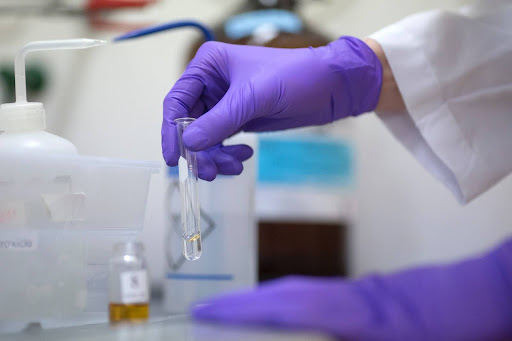
University of Puget Sound student engaging in organic chemistry research. Photo credit: Sy Bean.
Some of the Trump Administration’s most salient attacks on higher education have come in the form of funding cuts to research and fellowship programs. According to U.S. News and World Report, Trump has threatened to file lawsuits or cut funding to more than 60 universities. The administration has cut over $2 billion from major research programs at Ivy League colleges, and the Office of Management and Budget plans to cut funding in 2025 for 22 programs in the Bureau of Educational and Cultural Affairs which funds the Fulbright Scholarship Program, the Benjamin A. Gilman International Scholarship (which supports low-income students study abroad), the Creative Arts Exchange and several other programs that allow students to afford educational opportunities. Additionally, all but one of the 12 Fulbright board members resigned in June, citing tensions with the Trump Administration. The members who resigned stated that the Trump administration’s rejection of Fulbright awards went against the fellowships’ values of “free speech and academic freedom.” In 2025, President Trump prevented nearly 1400 Fulbright proposals from being approved, according to NPR, primarily through rejecting international students and banning certain words from research proposals. The Trump Administration has banned over 250 words and phrases from research proposals, including: “climate change,” “clean energy,” “sustainable,” “gender,” “pregnant person,” “biologically female/male” and “LGBT.” At the University of Puget Sound, professors, administration and students are seeing the effects of these federal cuts in fellowship and research programs.
A current Puget Sound senior applying for a Fulbright fellowship said that the process feels uncertain. (He requested to remain anonymous to avoid impacting his pending application.) “It’s a lot of trying to figure out how to move forward through uncertainty,” he said. He felt he had to avoid using terms related to diversity, equity and inclusion (DEI), which have been removed from federal websites and can get research projects cancelled. “It has been tough to write about what I’m interested in, my research interests, within the constraints of DEI words, for example. It’s hard to talk about a lot of things without talking about race, gender and even culture and cultural differences. How are you supposed to talk about Fulbright without culture?”
Madison Howard, who works as the Fellowship Advisor in the Academic Advising and Fellowships Office, agreed that applying for fellowships this year is more challenging than in the past, but reminds Puget Sound students that the office is there to support them. “While there is little that we can do about some of the more unpredictable things like last-minute funding cuts, there is support in place to help applicants find variety in what opportunities they may choose to apply to,” she said. Despite the cuts and pauses to federal programs, Howard feels more hopeful about the future of funding as the year goes on. “It makes it difficult for students to decide to dedicate time to applying for these awards, with the uncertainty of the funding, but I feel encouraged as we move forward through the year and past the initial announcement of cuts we saw earlier this year,” she said. “I know many people, including myself, are advocating for the continuation of these programs and the value they provide to our students, and in turn to our academic and national success. We have already seen decisions be reversed and funding be renewed, and people continue to advocate for higher education programs and funding opportunities for our scholars,” she said.
Professor Joel Eklof recently completed his doctorate researching permafrost at the University of Washington, which was funded by the Department of Energy and the National Science Foundation (NSF). In March 2025, the University of Washington began a hiring freeze where no new “non-essential staff” could be hired, which includes many graduate students and most post-doctoral researchers. The hiring freeze is still ongoing. He believes this pause will have long-term impacts and threaten opportunities for students pursuing research careers. “Having an entire year where no new scientists are being trained has obvious consequences as well,” he said. Eklof thinks that under the current administration, his NSF grant would not have been awarded because he studies climate change. “That one would not be funded now, because there was quite a bit of education and outreach work that is no longer under the National Science Foundation criteria and explicitly talked about climate quite a bit,” he said. The changes that he saw at the University of Washington are not unique. Universities and research institutions across the country have faced funding cuts, freezes and program removals. By September of 2025, Trump had cut more than 1,600 research proposal grants, over $1 billion of NSF-funded research. Still, Eklof is optimistic that research funding will be restored in the future. “When we go especially far in one direction, we often have a higher magnitude correction in the other direction as well,” he said.
Provost Drew Kerkhoff said there have been minimal financial cuts to student and professor research at the University. The real loss, he said, is the opportunities that these cut programs would have offered students and faculty. “The current administration’s cuts to federal research funding did not have a significant direct impact on our current funding levels, and I am not aware of any student research opportunities that were affected. Although one grant from the National Endowment for the Humanities was terminated early, we did manage to recoup all of the funds that had been expended to that point, so the loss was minimal. The larger, long-term impact has been lost opportunities for further funding,” he said. Additionally, if federal funding for research continues to decrease, it could affect the number of opportunities for students to do collaborative research with professors. “If federal commitments to research continue to decline, it could limit our ability to secure federal funding in support of collaborative research between students and faculty. While our programs are not dependent on such funding, it would be truly unfortunate,” he said.
The future of both federally funded research and fellowships remains uncertain. Although the Trump Administration has made consistent threats to higher education, people are fighting for a future where these opportunities still exist. Currently, the University administration is encouraging students to stay hopeful and keep advancing towards a future of academic excellence. Provost Kerkhoff shared that, although the budget is tight, the University is doing everything in its power to support both current and future research. “Our faculty and students have a lot of curiosity and ambition, and our budget is very tight, but we do everything we can to support research here at the University of Puget Sound,” he said.