
By GEORGE SLAATS
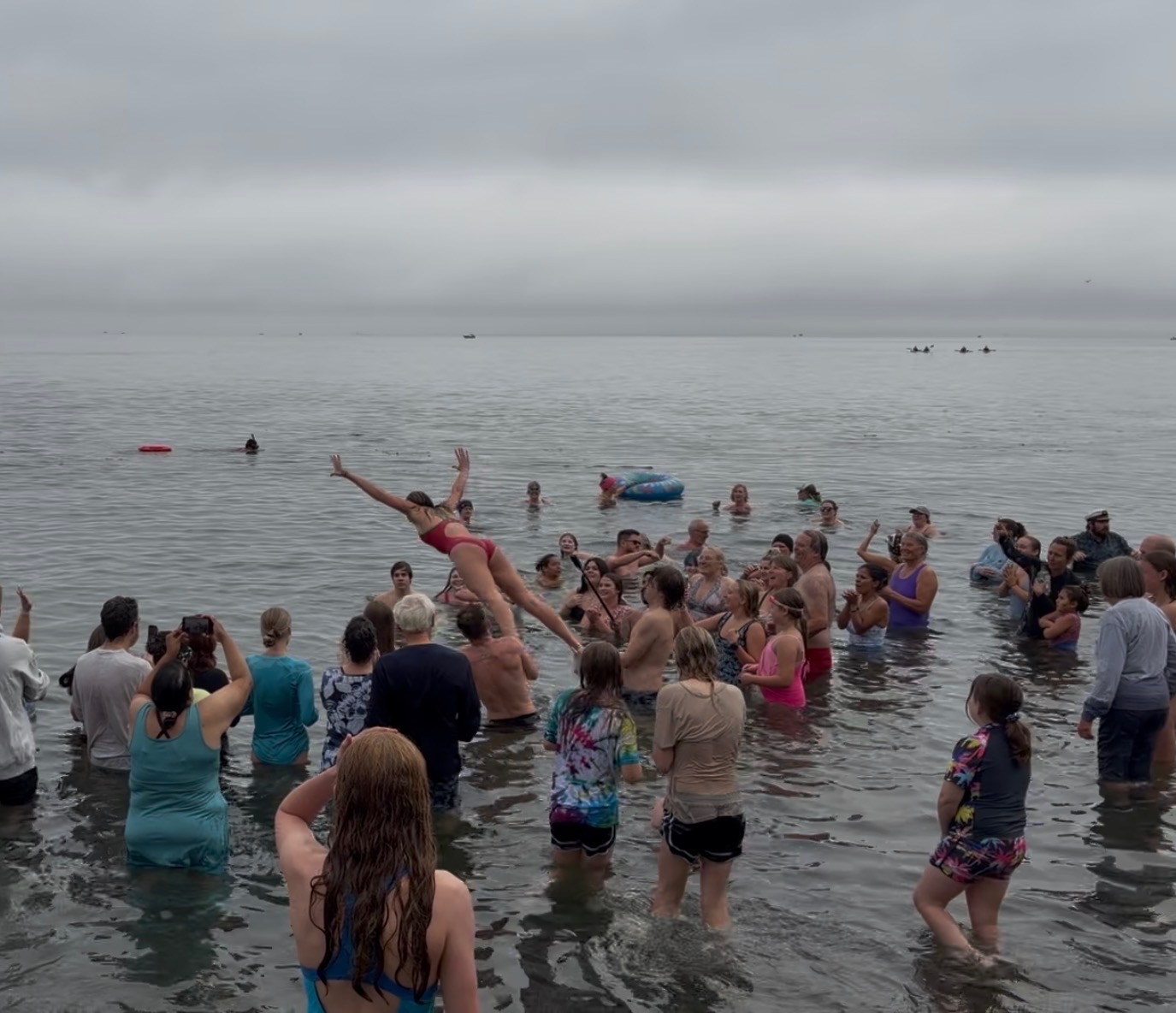
On the morning of Oct. 4, 2026, a crowd of around 200 people gathered on Owens Beach to join sisters Emma and Annie Stafki in jumping into the Puget Sound. The sisters have amassed almost 40,000 followers on their Instagram account, @two_girls_take_on_the_world, by jumping in the Sound and raising awareness for endangered orcas known as Southern Resident Killer Whales (SRKWs). With visitors from Portland, Seattle, Bellingham and more, the event was exactly one year in the making. The Stafki sisters made a series of posts inviting anyone to attend their final plunge. “Today we are at our 365th cold plunge to raise awareness for the critically endangered southern resident orcas. We’ve been cold plunging for every single day for an entire year now,” they told The Trail, “and so now we’ve invited everybody out to join us for our last one.”
The Stafkis do more than just plunge — they hope to inform people of the threats facing the SRKW population. “Each day we share a fact, and then we jump in the freezing cold water.” They shared some of their favorite facts about the orcas: “They are culturally and biologically unique more than any other orcas in the Pacific Northwest. They’ve got unique cultural traditions, and their biology is completely different from the Biggs orcas, the other ones that we have out here. I think that’s really special about them.” An example of their complexity is that “they have learned language and it’s not instinctual. So they actually have to teach their babies how to speak their language, and they have different dialects between the pods. And so it’s just completely unique,” Stafki said.
Peter Hodum, Professor of Biology and Environmental Studies and Sciences, also spoke to the grandeur of the Southern Residents. “They’re just so charismatic. They’re larger than life. The scales on which they live their lives, the distances they cover, the fact that they live as long as humans, as well as what folks know about their complex social dynamics and intelligence,” he said.
Across the three SRKW pods in the Puget Sound, there are only 76 individual orcas. The Southern Resident Killer Whale population was listed as endangered under the Endangered Species Act in 2005 and faces issues including prey availability, pollution, and boat interference. Lucy Martin (‘26) is part of the Educational Outreach team at the Center for Whale Research. “The biggest issue facing the SRKWs is lack of prey. There isn’t enough fatty Chinook salmon to go around. Our research shows that more whales are likely to die in low salmon years, and their family bonds weaken as they search for food,” she said. SRKWs are one of three orca ecotypes in the Pacific Northwest, and are the only ones that exclusively eat fish. Since the Puget Sound Chinook they eat are also a threatened species, protecting the whales has become a larger conversation. “We’re really thinking about systems-level restoration. You can’t talk meaningfully about the conservation of an upper trophic level predator without addressing what’s going on at those lower trophic levels in the food chain,” said Hodum. “We can cut down on boat traffic, and cut down on other stressors, but ultimately, they need to eat, and the food supply is something that’s not easily recoverable. It can be recovered, but it’s going to take decades.”
The Stafki sisters are part of a large network of individuals, nonprofits, and agencies working towards orca advocacy and recovery. “The Center for Whale Research has followed every Southern Resident Killer Whale for the last 50 years, creating one of the world’s longest-running studies of any wild mammal population. Our researchers record births, deaths, movements, behavior, and relationships between individual whales, providing the scientific foundation for their conservation,” Martin said. She encouraged local community members to get involved. “Learning more about the nature outside your door and advocating on behalf of the plants and animals that can’t speak for themselves is one of the best things you can do.”
Hodum, who has co-founded successful community-based conservation projects, agreed. “There’s all sorts of ways to get involved. Maybe it’s a beach cleanup, maybe it’s a letter-writing campaign, maybe it’s calling your local political representatives.” He also noted the value of more lighthearted events like a communal cold water plunge. “I think we have to find joy. It’s not sustainable if we don’t actually find joy in our lives too, and celebrate this amazing world that we live in. We still have orcas here, and we still can plunge in the Sound, and you can have harbor seals swim by you,” he said. “Leveraging the charisma of species or groups like the Southern Residents is a way to engage people to take action on things that they may not otherwise take action on without that connection.”
When asked about the future of their advocacy, the Stafkis said, “This might be the end of our campaign, but it’s still the beginning of our fight for the Southern residents. They’re still endangered, and we still need to protect them.”